
Rethinking Financial Literacy: Hanggang saan Aabot ang PHP20.00 mo?
- 6 days ago
- 5 min read
Article by: Armand Chinnoe Karlo F. Bernabeo, Julian Chase W. Valencia, and Germagne P. Verutiao
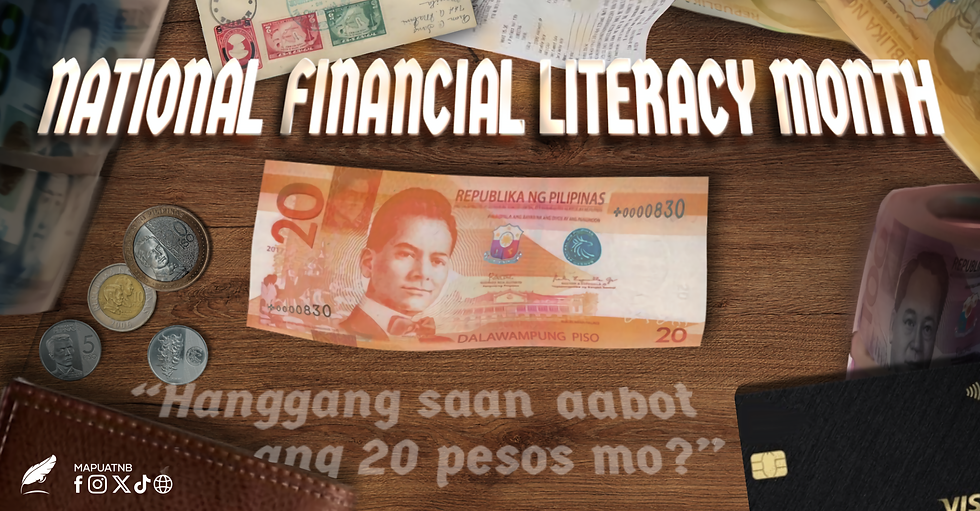
Graphics by: Chalxiene May B. Koh
Years ago, local television screens frequently asked viewers how far PHP20 could go. Back then, it was a lighthearted inquiry about a sweet ice cream treat on a sweltering afternoon. Today, the modern working-class Filipino asks a much heavier, more daunting version of that question—not about a single coin, but about their entire monthly paycheck.
The First Paycheck
As of January 2026, the Department of Budget and Management (DBM) states that Filipinos earn, on average, a starting salary of around PHP25,000. While this figure may sound substantial on paper to a graduating student, the reality is that the amount evaporates almost the moment it touches the hands of a young professional. Every payday, millions of Filipinos participate in a quiet, exhausting ritual of mathematics as their income is immediately partitioned to cover the skyrocketing costs of rent, utilities, groceries, and debt repayments, leaving little to no room for error or personal growth.
The national conversation frequently stalls at the painful reality of rising prices, yet we rarely examine the underlying mechanisms we use to manage the money we actually retain. Financial literacy remains a topic of intense contention in a world flooded by consumerist advertisements and salaries that barely keep pace with the cost of living. Recent studies have shifted focus from merely defining financial literacy to identifying the specific competencies required to be considered financially capable. Researchers have identified four critical pillars—basic numeracy, compounding interest, inflation, and risk diversification—as the primary benchmark for measuring financial health. While these metrics do not always account for the
nuances of credit and loans, they serve as essential, digestible points of reference for the average earner.
Unfortunately, for a nation of over 117.7 million people, financial literacy remains painfully low as many Filipinos are locked in a perpetual "survival mode" amid surging costs for basic necessities. This struggle is reflected in the nation’s financial metrics from the previous year; although 74% of Filipinos answered basic financial literacy questions, significant disparities remain. There are still glaring gaps in financial understanding and stability across different generations, geographic locations, and socioeconomic backgrounds, highlighting the urgent need for a more inclusive and practical approach to financial education in the Philippines.
As per IBON Foundation, a family of five residing in the National Capital Region should earn or receive at least PHP1,266 per day, equivalent to PHP27,537 per month, to live decently or to cover all basic necessities. This is a far reality from the current mandated wage of PHP695 per day.
Revving Inflation Rates
Conversely, workers who own cars face a distinct set of obstacles. The convenience of a private vehicle is frequently offset by mounting maintenance costs and the relentless surge in gasoline prices—fluctuations that act as a silent tax on every basic necessity. In the Philippines, inflation is a permanent passenger in the delivery trucks that transport rice and vegetables to urban markets. According to the Philippine Statistics Authority’s April 2026 National Summary, headline inflation accelerated to 4.1 percent in March, driven primarily by a 9.9 percent jump in the transport index.
As a result, modern workers find that a significant portion of their take-home pay is consumed before they even reach the grocery checkout. They are forced to navigate a marketplace where the costs of fuel and logistics have vastly outpaced the slow growth of their base salaries. In this environment, any "remaining" money is often an illusion, as it has already been claimed by the gas tank and the dinner plate long before the month ends.
Beyond price surges, the rapid rise of digital wallets presents a new challenge to financial literacy. While these platforms offer unprecedented convenience, many also provide easy access to high-interest cash lending. For the average Filipino worker already struggling with inflation, this instant access to debt can create a dangerous financial trap. Research shows that most Filipinos now maintain at least one digital wallet, with some platforms even offering "junior" accounts for children. This digital shift has also led to a yearly increase in cyber-fraud; a lack of foundational financial education leaves the population vulnerable to investment scams and phishing, further eroding the hard-earned savings of the working class.
Despite these clear systemic pressures, many find themselves falling deeper into a cycle of debt. This is often compounded by the traditional "Bahala Na" mindset, a cultural inclination toward fatalism that, while a source of resilience, can sometimes hinder long-term financial planning. In an economy that feels increasingly stacked against them, Filipinos are forced to find creative, albeit often precarious, ways to combat their growing financial burdens.
Staying Financially Literate
Financial literacy may be a tough nut to crack, but with information now more accessible than ever via the internet, it is the perfect time to advocate for these skills. Understanding money is just as critical as any other form of literacy in the modern world. Through a Mapúan lens, we must remain vigilant, leveraging our education to combat the economic crisis by mastering the fundamentals of financing and budgeting. By learning these skills now, we can help avert the broader financial challenges facing the Philippines.
One way to drive this change is by integrating financial education through workshops, infomercials, and seminars. These initiatives can gradually foster better habits, motivating students to manage their resources effectively. The goal is to ensure that every student can navigate their daily lives with confidence, rather than defaulting to "survival mode" just to get by.
A popular financial strategy often shared on platforms like TikTok is the 50-30-20 Rule. This framework suggests dividing your income into three clear categories: 50% for needs, 30% for wants, and 20% for savings or emergencies. In an era of multiple financial crises, applying such a rule can provide a much-needed structure and ease the constant worry regarding personal expenses.
Finally, it is vital to closely study the implications of interest rates before taking out any loans. As the presence of cash-lending apps becomes inevitable, staying vigilant and fully understanding the terms and conditions is essential. By being informed today, we protect our financial freedom for the future.
Ultimately, money remains a fleeting yet unavoidable necessity of the modern world. The value of PHP20 today is now very far from what it was worth 10 or 20 years ago, a quiet reminder of how its purchasing power continues to weaken in this economy. It puts the question of “Hanggang saan aabot and PHP20 mo?” in a different light.
While staying financially literate in an era of constant economic flux is a daunting challenge, it is the most powerful tool we possess to reclaim our agency. By transforming our relationship with every peso from a source of anxiety into a strategy for stability, we ensure that we are no longer just surviving the current; we are learning how to navigate it. The future belongs to those who understand that while the value of currency may change, the value of being informed is absolute.
References:
Bangko Sentral ng Pilipinas. (2025). 2024 National Strategy for Financial Inclusion survey (NSFI): Tracking digital adoption and financial health in the Philippines. https://www.bsp.gov.ph/SitePages/InclusiveFinance/NSFI.aspx
Bangko Sentral ng Pilipinas. (2026, March). Monetary policy report: Navigating global oil volatility and inflation targets. https://www.bsp.gov.ph/SitePages/MediaAndResearch/InflationReport.aspx
Department of Education. (2021, July 8). Integration of financial literacy in the K-12 curriculum: Progress report on the pilot implementation of DepEd order no. 022. Bureau of Curriculum Development. https://www.deped.gov.ph/2021/07/08/deped-expands-financial-education-in-k-to-12-to-improve-literacy-of-filipinos/
Manila Standard. (2025, Month Day). Philippine financial literacy rose to 74% in 2025, BSP says. https://manilastandard.net/business/banking-report/314728090/philippine-financial-literacy-rose-to-74-in-2025-bsp-says.html
OECD. (2023). PISA 2022 results (Volume IV): Financial literacy. OECD Publishing. https://doi.org/10.1787/5a849c2a-en
Philippine Statistics Authority. (2026, April 7). Summary inflation report consumer price index (2018=100): March 2026. https://psa.gov.ph/statistics/inflation-and-consumer-price-index


Comments